


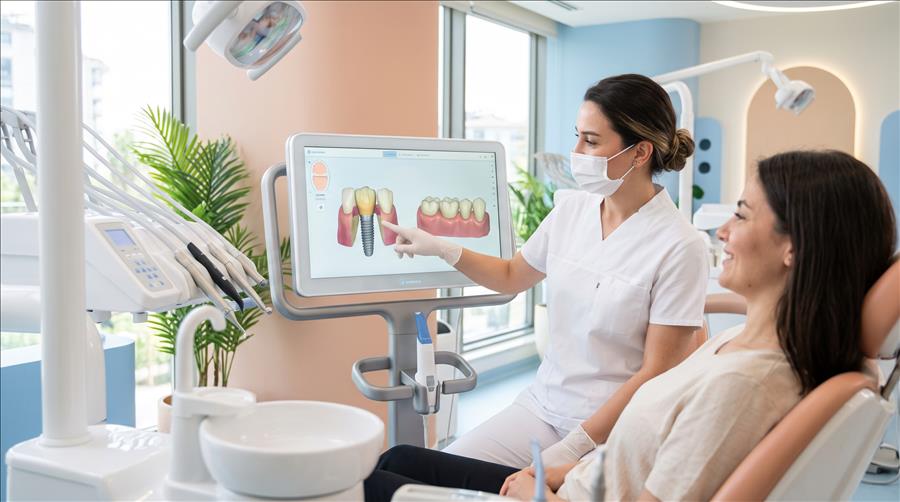
When you lose one or more teeth due to extraction or trauma, you quickly realize that the resulting gap is not merely an aesthetic concern—over time, it disrupts your bite balance and causes neighboring teeth to shift out of alignment. At this stage, patients face a fundamental dilemma: "Should I get a dental implant anchored into the jawbone to replace my missing tooth, or should I opt for a dental bridge supported by adjacent teeth?" While both options offer distinct clinical advantages in modern dentistry, making the right choice for long-term biological preservation depends on the current condition of your jawbone and neighboring teeth.
What Are Dental Implants and Dental Bridges?
A dental implant is an independent restorative solution consisting of a biocompatible titanium post surgically placed into the jawbone to act as an artificial tooth root, topped with a porcelain or zirconia crown; in contrast, a dental bridge is a fixed prosthetic system made of connected crowns that fills the gap by reshaping and using the healthy adjacent teeth on either side as structural anchors (abutments). While an implant integrates directly with the bone without touching neighboring teeth, a bridge relies on mechanical support from existing teeth to span the empty space.
The core biological and mechanical working principles of both treatments include:
- Dental Implant: Fuses with the jawbone at a cellular level (osseointegration) to mimic a natural tooth root. It completely eliminates the need to grind down or alter healthy adjacent teeth.
- Traditional Dental Bridge: Requires no surgical procedure and is typically completed within a short timeframe of about one week. It distributes chewing forces onto the neighboring teeth capped to support the bridge.
Dental Implant vs. Dental Bridge: Key Differences
Choosing between a dental implant and a bridge is shaped by the health of surrounding teeth, jawbone volume, treatment duration, and longevity expectations. The clinical comparison between the two options is outlined below:
| Clinical Criteria | Dental Implant | Dental Bridge (Zirconia / Porcelain) |
|---|---|---|
| Impact on Adjacent Teeth | None (healthy neighboring teeth remain completely untouched) | Teeth in front of and behind the gap must be ground down |
| Jawbone Health | Stimulates bone tissue and halts bone resorption (shrinkage) | Jawbone beneath the missing tooth area continues to resorb over time |
| Treatment Duration | Average of 2 to 4 months due to bone integration | Average of 5 to 10 days since no surgery is required |
| Lifespan & Longevity | Can last a lifetime with proper oral hygiene and check-ups | Average of 10 to 15 years, depending on abutment tooth health |
| Oral Hygiene & Cleaning | Brushed and flossed individually just like natural teeth | Requires special floss threaders or interdental brushes under the pontic |
Which Treatment Should Be Preferred in Which Situation?
The ideal protocol for replacing missing teeth is determined following an intraoral examination and 3D dental tomography (CBCT) to evaluate jawbone density. As the dental team at Akçadent Oral and Dental Health Polyclinic, we always prioritize dental implants in patients whose adjacent teeth are completely healthy in order to prevent unnecessary tooth structure loss.
A Dental Implant Is Ideal When:
- The neighboring teeth in front of and behind the gap are cavity-free and completely healthy,
- The height and thickness of the jawbone provide sufficient volume to support an implant (or can be augmented with bone grafting),
- Back molars are missing and there is no posterior tooth available to anchor a traditional bridge,
- The goal is to prevent long-term jawbone loss and invest in a permanent, lifelong solution.
A Dental Bridge Is Ideal When:
- The teeth adjacent to the gap already have large fillings, fractures, or structural loss requiring full-coverage crowns,
- Advanced bone loss is present and the patient prefers to avoid supplementary bone grafting surgeries (such as a sinus lift),
- Surgical procedures are contraindicated due to uncontrolled diabetes, bone metabolism disorders, or recent radiotherapy,
- Specific personal or clinical circumstances require fast aesthetic and functional restoration within a week.
Dentist Note: Although a dental bridge may initially seem like a faster and more economical option, grinding down two completely healthy neighboring teeth to replace a single missing tooth can expose those support teeth to future decay or root canal needs. Furthermore, because the jawbone beneath the false tooth (pontic) receives no chewing stimulation, it gradually resorbs over the years—leading to gum recession and visible gaps under the bridge. If your bone structure is suitable, a dental implant is the most biologically protective long-term investment.
Frequently Asked Questions
Is dental implant surgery much more painful than getting a bridge?
No. Implant placement is performed under local anesthesia, ensuring you feel no pain during the procedure. With modern digital surgical techniques, placing a single implant takes approximately 15 to 20 minutes, and recovery is comfortably managed with standard over-the-counter pain relievers.
How soon after a tooth extraction should an implant or bridge be placed?
If an extraction space is left untreated for too long, adjacent teeth tilt into the gap and the opposing tooth over-erupts, disrupting your bite. Depending on your dentist's evaluation of bone healing, treatment is generally recommended within 2 to 3 months post-extraction (or during the same appointment in immediate-placement cases).
Can I have my old dental bridge removed and replaced with implants?
Yes, your existing bridge can be removed to place a dental implant in the missing tooth space, while the supporting abutment teeth are restored with individual crowns. However, if significant bone loss has occurred beneath the bridge over the years, a bone graft procedure may be required prior to implant placement.